
Time tracking is critical to business operations—but only when it’s accurate and compliant. OfficeClip’s Rules feature empowers administrators to enforce organizational policies automatically, catch errors before they propagate, and ensure every timesheet meets your standards before submission or approval.
Without guardrails, inconsistencies accumulate. Missed entries, incomplete data, policy violations, and billing errors can compound across hundreds of timesheets. OfficeClip’s Rules prevent problems at the source.
Why Timesheet Rules Matter?
Organizations face common timesheet challenges:
- Incomplete or Late Submissions – Employees forget to track hours or submit timesheets after the deadline, disrupting payroll and project tracking
- Policy Violations – Hours don’t meet minimum requirements, maximum limits, or project allocation rules
- Data Quality Issues – Missing project assignments, negative hours entered by accident, or incomplete task categorization
- Approval Bottlenecks – Invalid timesheets reach approvers, requiring manual review and rejection cycles
- Billing Errors – Incorrectly tracked hours lead to inaccurate invoicing and revenue loss
- Compliance Risks – Inadequate tracking or unvalidated entries fail audits or regulatory requirements
Automated timesheet rules catch these issues immediately, preventing them from moving downstream.
How Timesheet Rules Work?
OfficeClip Rules operate in two modes: Warnings and Errors
Warnings
- Flag issues but allow submission
- Alert both the employee and approver to review before finalizing
- Useful for guidance without hard restrictions (e.g., “overtime detected”)
Errors
- Block submission entirely
- Force correction before the timesheet can proceed
- Ideal for mandatory compliance requirements (e.g., “minimum 8 hours daily”)
Types of Rules You Can Configure:
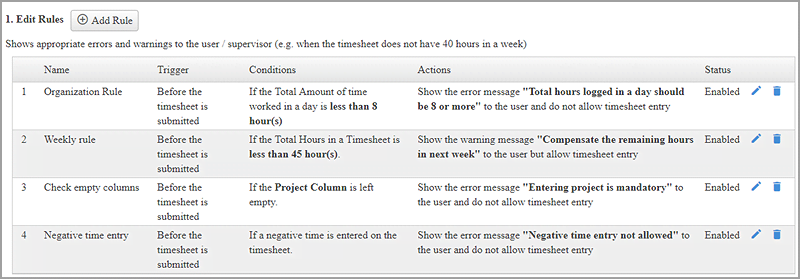
OfficeClip lets you create custom rules around your operational and compliance requirements:
Total Hours Rules
- Set minimum and maximum hours allowed per timesheet period
- Ensure employees log exactly the hours required (e.g., 40 hours/week, 80 hours/month)
- Prevent timesheets with incomplete or excessive hours from advancing
Daily Hours Rules
- Enforce minimum or maximum hours worked per day
- Example: “Employees must log at least 8 hours daily”)
- Catch partial days or unusual schedules before approval
Period Hours Rules
- Validate total hours across an entire timesheet period (week, month, etc.)
- Ensure consistent utilization and prevent under/over-tracking
- Support varying pay periods and project cycles
Required Field Rules
- Prevent submission if critical fields are left blank
- Examples: Project assignment, task category, cost center, client billing code
- Reduce data entry errors and ensure complete records
Negative Hours Prevention
- Automatically flag if negative time is entered (common data-entry mistakes)
- Protect against accidental or deliberate hour reductions/li>
- Ensure accurate payroll and billing calculations
Setting Up Timesheet Rules
For Administrators:
- Define Your Policy – Determine what hours, assignments, and validation standards apply to your organization
- Configure Rules – Set parameters (minimums, maximums, required fields, etc.)
- Choose Rule Type – Select Warning or Error mode for each rule
- Assign Scope – Apply rules to all employees, specific departments, or particular projects
- Test & Deploy – Verify rules work as intended before enforcing organization-wide
For Employees:
- See rule violations immediately when entering hours
- Receive clear error messages explaining what’s required
- Correct issues in real-time before submission
Benefits of setting up rules in Timesheet:
- Enforce Compliance – Ensure timesheets meet organizational, industry, or contractual standards automatically
- Reduce Errors – Catch data-entry mistakes, missing assignments, and policy violations before they cause problems
- Streamline Approvals – Approvers receive only valid timesheets, reducing review cycles and delays
- Improve Data Quality – Maintain consistent, complete, audit-ready records
- Prevent Billing Errors – Validate project and task coding to ensure accurate invoicing
- Save Time – Eliminate manual review of invalid timesheets and repetitive correction cycles
- Support Compliance Audits – Demonstrate adherence to time-tracking policies and regulatory requirements
- Flexibility – Use warnings for guidance, errors for hard requirements—or both
- Scalability – Rules apply uniformly across your entire organization or specific teams
- Customization – Create rules that match your unique business processes and policies


