
Running a business today means juggling multiple needs like customer management, project tracking, time tracking, invoicing, and communication. Many small and mid-sized organizations start by using individual tools for each function. But over time, this fragmented setup often becomes expensive, inefficient, and difficult to manage.
An all-in-one solution brings all these capabilities under one platform, simplifying operations and providing a better return on investment.
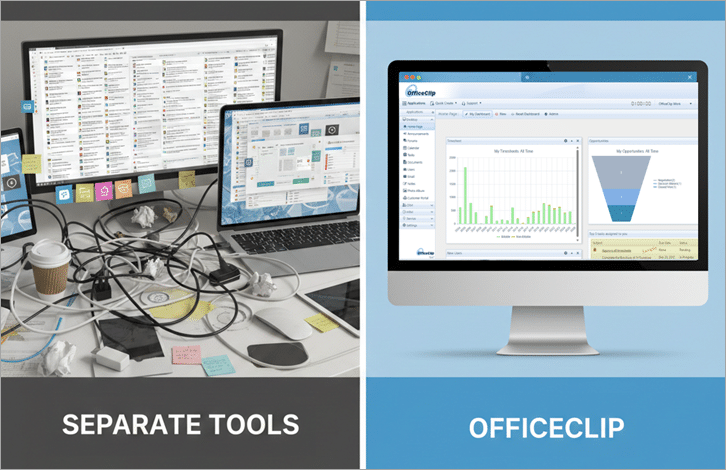
While the seemingly lower initial cost of fragmented tools can be tempting, this article argues that the true, long-term cost measured in time, money, and productivity clearly favors the integrated, all-in-one platform.
The Hidden cost of separate tools:
At first glance, using multiple specialized tools may seem affordable. You pick the best app for CRM, another for timesheets, one for invoicing, and yet another for project management. However, the real cost extends beyond the monthly subscription fee. Let’s see how:
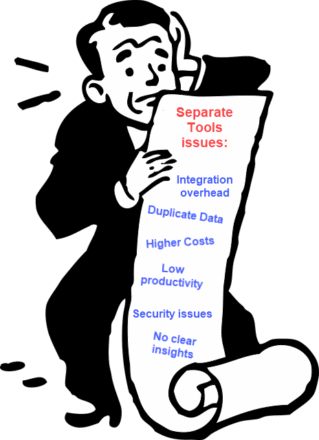
- Integration overhead: Connecting multiple apps requires third-party connectors or manual imports and exports, which can lead to errors and wasted hours.
- Duplicate data: When contacts, tasks, or timesheets exist in scattered systems, inconsistencies and duplication become inevitable.
- Training complexity: Each tool has its own interface and learning curve, making it harder for teams to adopt consistently. Training the staff becomes more time-consuming and expensive as they need to handle multiple, diverse systems.
- Cumulative costs: Paying for individual subscriptions can add up quickly. What appears as small monthly charges per tool becomes a large yearly expense.
- Loss of visibility: Fragmented tools make it difficult to get a unified picture of operations, projects, or customer interactions.
- Reduced productivity: Employees lose momentum and focus by constantly switching between different applications, user interfaces, and login credentials. This switching between the tools disrupts workflow continuity, leads to errors, and significantly lowers overall team productivity.
- Security Vulnerabilities: Managing security across numerous vendors, each with its own protocols and patch schedules, exponentially increases your attack surface. An all-in-one solution, managed under a single security umbrella, offers a more consistent and robust defense.
Why will using an All-in-One solution prove to be a smart, sustainable choice?
An integrated platform like OfficeClip streamlines operations by combining multiple modules like CRM, projects, timesheets, and billing into one ecosystem. Let us see the benefits of integrated business platform:
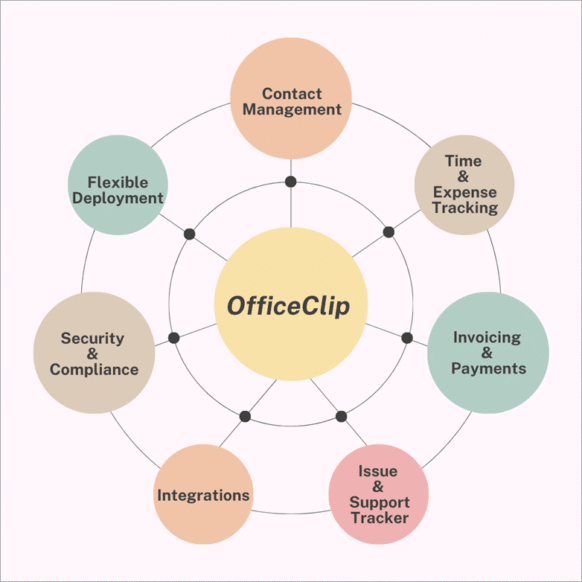
- Seamless connectivity: Teams don’t need to switch between apps or worry about syncing data. Every module works together automatically.
- Time savings: By eliminating repetitive tasks and integrations, businesses can focus more on productivity and growth.
- Cost efficiency: One subscription replaces multiple licenses, resulting in predictable and lower overall costs.
- Simplified management: With one login and centralized data, setup, training, and maintenance become easier.
- Better insights: Since data flows freely across modules, managers can generate real-time reports and analyze performance holistically.
- Enhanced Usability and Scalability: A unified interface offers a consistent user experience, reducing the learning curve for new employees and boosting adoption across the entire organization. Furthermore, as your business grows, an all-in-one platform is built for scalability. Adding new users or expanding into new functionalities is a simple process within the existing framework, ensuring your technology evolves with your company, not against it.
Affordability and Long-Term ROI:
All-in-one platforms often come with tiered pricing plans that scale as the business grows. While the initial cost might seem higher than one standalone app, the long-term savings from reduced maintenance, fewer integrations, and improved team productivity outweigh that difference.
Businesses save money directly by simplifying IT support and eliminating the need to troubleshoot problems between different tools.
A clear comparison showing how separate tools differ from all-in-one solutions, with a focus on why the integrated approach delivers better value for businesses.
Comparison Table between Separate tools vs All-in-One Solutions: OfficeClip as a smarter choice:
When managing business operations, many companies start with a handful of separate tools like a CRM software here, a timesheet tracker there, plus project management and invoicing apps. While this approach may seem flexible and affordable at first, it usually leads to inefficiencies and increasing costs over time. OfficeClip offers a complete all-in-one solution simplifying your workflow and maximizing ROI.
| Features | Separate Tools | OfficeClip All-in-One solution |
| Setup and Integration | Requires connecting multiple apps (CRM, project management, timesheets, invoicing, etc.), often through third-party tools or manual exports. | OfficeClip integrates CRM, project management, timesheets, and invoicing in one platform, eliminating setup complexities.Single setup handles all functions within one system, with built-in integration. |
| Data Management | Data is scattered across platforms, leading to duplication, missing updates, and inconsistent information. | A centralized database in OfficeClip ensures all information stays updated and easily accessible across modules. |
| Cost Structure | Multiple monthly subscriptions add up quickly. Integration tools or API fees further increase expenses. | One affordable subscription covers all core business functions, offering cost predictability. |
| Efficiency and Time Savings | Switching between tools slows workflows and requires repetitive data entry. Also reduces productivity. | Our Unified workflow eliminates duplication and saves time by automating data sharing between modules. |
| Maintenance and Support | Different vendors mean separate support channels, upgrades, and renewal cycles. | We provide complete support and maintenance, reducing administrative effort. |
| Scalability | Difficult to scale since adding users or tools may require separate upgrades and compatibility checks. | Easily scalable with flexible pricing tiers and integrated functionality as the business grows. |
| User Training | Each tool has a unique interface and learning curve, adding to the training burden. | One consistent interface across modules makes adoption quicker and easier. |
| Reporting and Insights | Limited visibility, as data from multiple sources must be combined manually. | OfficeClip’s centralized reporting provides real-time analytics and a complete business overview. |
| Long-Term ROI | Hidden costs from disjointed data, manual work, and multiple billing sources reduce overall value. | OfficeClip ensures better return on investment with lower total cost of ownership and higher team productivity. |
| Depth & Customization | Specialized tools offer deep features and precision control, but often come with higher overall costs, increased complexity, and greater management overhead. | While it may not offer every advanced or niche feature found in best-of-breed applications, OfficeClip provides a balance of essential customization—such as custom fields, configurable workflows, and personalized reporting—within an intuitive interface. This approach delivers the flexibility most organizations need, without unnecessary complexity or overhead. |
Why OfficeClip is the right choice for businesses?
Individual tools might solve quick problems, but they eventually lead to messy workflows and rising costs.
An all-in-one solution like OfficeClip offers a better way forward by keeping your CRM, timesheets, projects, and billing in one place. By removing the hassle of switching between apps, your team can focus on what actually grows the business.
The result is a more efficient, scalable organization that saves both time and money.

Deepa Kapoor is an online writer for small businesses. She loves to write on the advancements of new technologies and how it affects our lives. She always explores ways to make small businesses more profitable. When not writing, she enjoys reading books and cooking exotic traditional food.


