
Why Small Businesses are bleeding money on Features they don’t need?
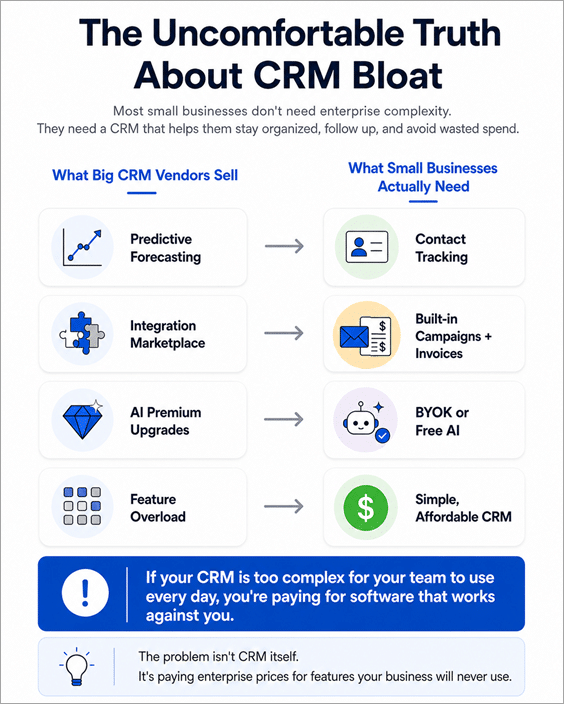
Most small businesses were sold the wrong CRM dream.
You are not frustrated because your business is too small for CRM.
You are frustrated because your CRM was built for a company ten times your size.
The software industry bullied small businesses into believing enterprise complexity equals professionalism.
Buying an enterprise CRM for a 10-person business is like using a sledgehammer to crack a nut.
Big CRMs are built for:
- 500-person sales teams.
- Dedicated IT departments.
- CRM administrators.
- Consultants and training programs.
- Enterprise software budgets.
When a 10-person business tries to use software built for a 500-person sales organization, it usually does not accelerate growth.
It grinds work to a halt.
What small businesses actually need is simple:
Contacts – Conversations – Follow-ups – Deals – Tasks – Customer history.
Somewhere along the way, CRM vendors convinced small businesses that simple is amateur — and expensive complexity is professional.
The problem is not that big CRMs are useless:
The problem is that many small businesses are paying for a machine designed for someone else.
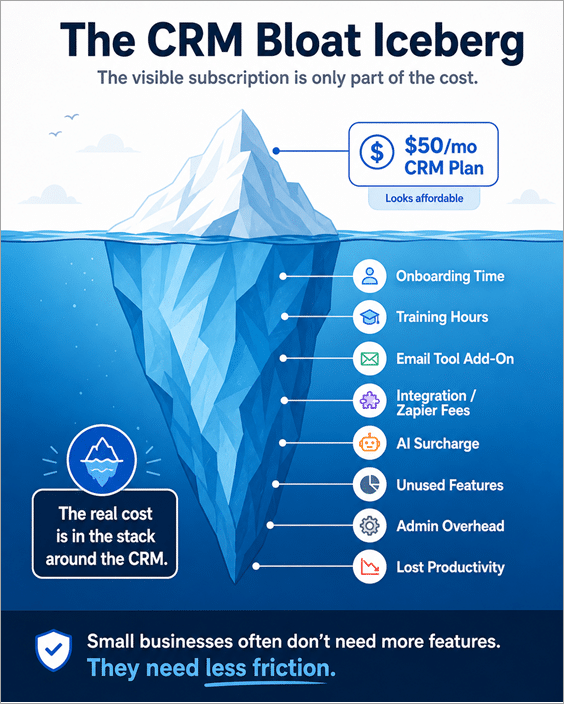
The monthly subscription is only the part you can see.
That is the trick.
The CRM plan looks affordable on the pricing page. Maybe it says $50 per month. Or it is $25 per user. Or the entry-level tier looks reasonable enough to start.
But the real cost starts after you sign up:
- You need onboarding and training.
- You need an email tool and an integration connector. You need someone to fix the connector when it breaks.
- You need a higher tier to unlock the feature you thought was included.
- You need an AI add-on because suddenly “basic productivity” is now a premium feature.
- And after all that, your team still uses spreadsheets because the CRM is too painful to update.
That is the CRM bloat iceberg.
The visible price is not the real price. The real price is the stack around the CRM.
The Lies:
🔮 Lie #1: Predictive Forecasting Will Transform Your Business
Reality: Most small businesses do not need AI revenue prediction. They need to know who to call, what was promised, and which follow-up is overdue.
🧩 Lie #2: Seamless Integration Means Lower Cost
Reality: Integration marketplaces can become subscription traps. The CRM is cheap until you add email tools, invoice tools, automation connectors, and reporting add-ons.
🤖 Lie #3: CRM AI Should Cost a Premium
Reality: AI should be a productivity layer, not a paywall. Small businesses should have options like managed AI, BYOK, or free/limited AI for basic work.
🧰 Lie #4: More Features Means More Value
Reality: A feature your team never uses is not value. It is clutter. More menus, modules, and dashboards often make adoption worse.
🏢 Lie #5: Enterprise CRM Makes You Look Professional
Reality: Your customers do not care how complex your CRM is. They care whether you remember the conversation, send the proposal, and follow up on time.
The Right-Sized CRM Philosophy:
A small business does not need to reject CRM. That would be the wrong lesson.
The real problem is not CRM itself. The problem is using a CRM designed for a company with a sales operations department, an IT team, and a software budget bigger than your payroll.
A right-sized CRM does something different. It does not try to impress you with every possible feature. It helps your team answer the questions that actually matter every day.
What a Small Business CRM Should Help You Answer:
- Who is this contact? You should be able to quickly see the customer, company, phone, email, and relationship history without hunting through screens.
- What did we last discuss? A good CRM should preserve notes, calls, emails, and important context so every conversation starts from memory, not guesswork.
- What needs to happen next? The system should make follow-ups obvious. If someone needs a call, proposal, invoice, reminder, or task, it should not be buried.
- Who owns the follow-up? Small teams lose deals when responsibility is vague. A CRM should make ownership clear.
- What opportunities are open? You do not need predictive theater. You need a clear view of real deals, pending proposals, and active customer needs.
- What customer work is connected? Contacts, tasks, campaigns, invoices, notes, and history should not live in separate disconnected systems.
A right-sized CRM does not make your business manage the software. It helps the software manage the work.
The Right-Sized CRM Test:
A CRM is right-sized for your business if your team can use it without a consultant, update it without resistance, and trust it without maintaining five other tools around it.
It should be:
- Simple enough to use daily.
- Structured enough to prevent lost information.
- Integrated enough to avoid subscription sprawl.
- Flexible enough to support practical AI.
- Affordable enough to make business sense.
The OfficeClip Difference:
OfficeClip was built for businesses that need practical customer management without enterprise CRM bloat.
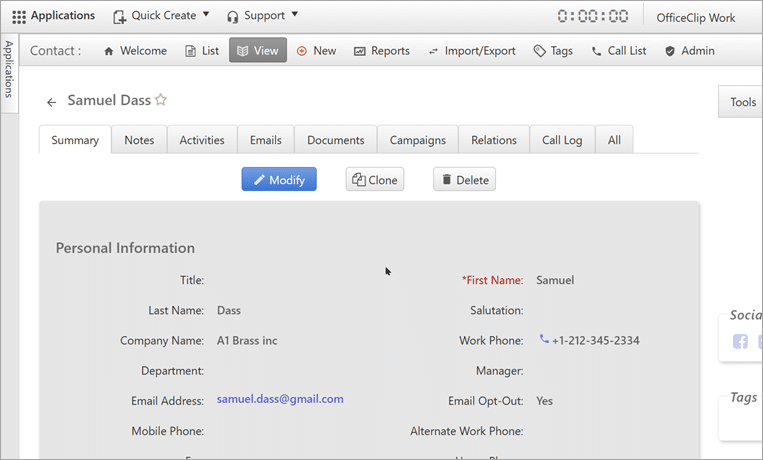
OfficeClip focuses on the everyday work small businesses actually need: contacts, notes, follow-ups, tasks, and customer history.
It helps small teams manage contacts, track conversations, schedule follow-ups, assign tasks, run campaigns, connect invoices, and keep customer history organized — without forcing the business into a maze of add-ons, consultants, and unused features.
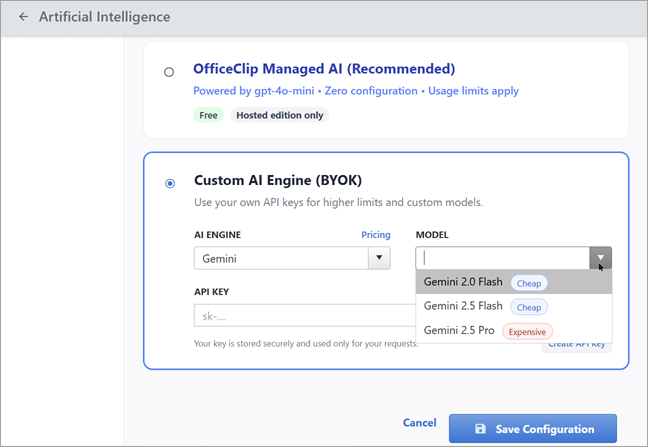
OfficeClip gives businesses a practical choice: use managed AI for simplicity, or bring your own key (BYOK) for more control over provider, model, and cost.
OfficeClip also treats AI as a practical assistant, not a locked premium gimmick. Businesses should be able to use managed AI for convenience or bring their own AI key for more control over provider, model, cost, and usage.
The result is a right-sized CRM philosophy:
- Less software theater.
- More usable customer work.
- Fewer hidden costs.
- More control.
OfficeClip is not anti-CRM. OfficeClip is anti-bloat.

SK Dutta is a software architect and creator of OfficeClip Suite of products. He loves to design and develop software that makes people do their job better and more fun. He always explores ways to improve productivity for small businesses. He is also an avid reader in many areas, including psychology, productivity, and business.


