
In many workplaces, miscommunication and weak collaboration are the hidden reasons behind missed deadlines, frustrated customers, and lost revenue. Without clarity on priorities, teams often duplicate efforts or act on incomplete data, stalling projects and fueling unnecessary conflict.
By intentionally fostering a culture of clear communication and collaboration, businesses can reduce errors, speed up delivery, and give every team member the information they need to succeed.

Ultimately, prioritizing these communication strategies protects the bottom line and ensures long-term operational health.
Like there is a famous quote:
Alone, we can do so little; together, we can do so much.
– Helen Keller
According to a survey, the main reasons for miscommunication are:
- Lack of effective leadership
- Unclear objectives
- Personal differences between employees
- Lack of usage of proper tools
In this article, we’ll look at how poor communication hurts your business, what effective team communication really means, and how the right habits and tools can keep everyone aligned.
Table of Contents:
- Negative impacts of Poor Communication
- Communication Statistics
- Benefits of Effective Communication
- 6 pillars of Communication
- 5 steps to improve Team Communication
- Tips for maintaining communication in remote work
- Using OfficeClip for better Communication
- The power of teamwork – animation
- Conclusion
The negative impacts of Poor Communication on businesses:
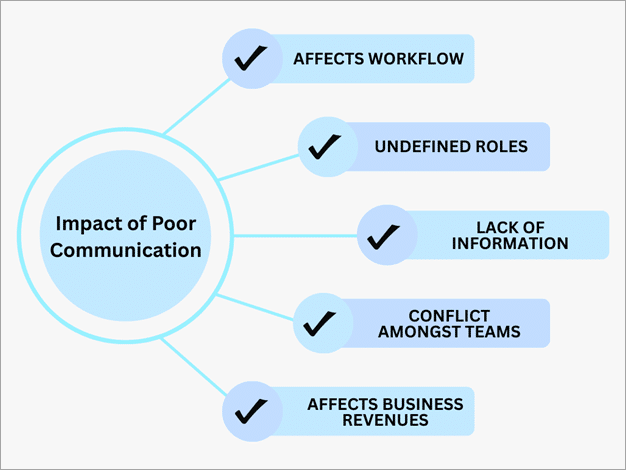
- How poor communication disrupts workflow and productivity: Communication is the key to productivity and employee efficiency. Without effective communication, the work hierarchy will show negative impacts and consequently affect the work and business. In addition, if the work related information is not transferred or understood properly, then it is difficult to meet the expectations set by managers.
- Team members will be unaware of their tasks and responsibilities: They need to know what tasks are assigned to them. Without communication or in the absence of any communication tool, team members will not know what projects or tasks they are going to work on.
- Lack of accurate information: While working on any customer’s sales lifecycle, usually, there is an exchange of notes and communication between customers and company employees. This communication needs to be recorded in one place so that other team members can access it while working on the sales lifecycle. So, a proper tool or team collaboration is a must.
- Conflicts amongst team members: While working on any projects, some people may perform tasks at their convenience resulting to delays in work and affecting further workflow. This may lead to conflicts amongst the team members.
- How poor communication will affect business revenues: All the above effects will result in low productivity and affect employees’ morale as they will not be motivated to work sincerely and will affect their efficiency. This will directly affect the business revenues in the future.
Communication Stats That Impact Team Performance:
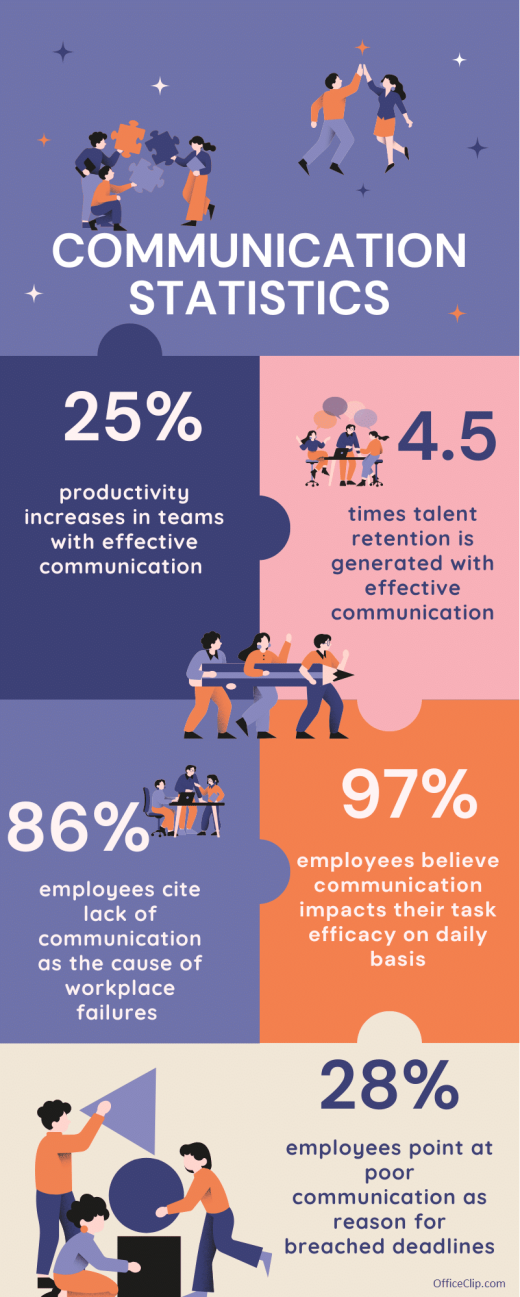
Data source: pumble.com, cmswire.com, yourbusiness.azcentral.com
According to David Grossman’s report, “In a survey, which included 400 large companies and 100,00 employees, the cost of poor communication barriers that arise in the workplace stands at $62.4 million per year per company.Hence, proper team communication and collaboration are the foundation for businesses. It plays a vital role in achieving organizational goals.
The same goes for the management. It is the responsibility of the management to ensure that your team members understand what exactly is expected from them. Effective communication between the management and team members will ensure long-term success for your business.
Top benefits of effective communication:
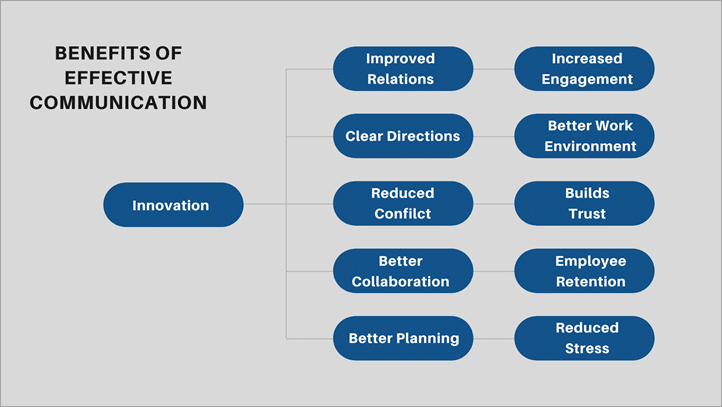
- Problem-solving and innovation: When people communicate effectively, they can better identify and solve problems. They can also share ideas and collaborate on new solutions, leading to innovation.
- Improved team relations: Effective communication builds trust and rapport, leading to a more cohesive and productive team.
- Clear directions: Employees will be well aware of their tasks and responsibilities with clear directions creating a smooth workflow
- Reduced conflict: When people communicate effectively, they can better resolve conflicts positively and productively. This creates a more harmonious and productive work environment.
- Increased collaboration: Clear communication drives better decision-making, problem-solving, and the kind of innovation needed to build strong teams. Ensuring everyone is on the same page requires the right approach for every occasion—while daily workflows rely on robust digital collaboration tools, special corporate events or key internal meetings often benefit from a more personalized touch, such as using services to print custom invitations to set the right tone from the start.
- Encourages more discussions and implementation of better planning: With better communication, employees can discuss their ideas and plan those to implement with the management without hesitation.
- Increased employee engagement and productivity: When employees feel they are being heard and understood, they are more likely to be engaged in their work and productive.
- Positive work environment: Effective communication can create a more positive and productive work environment boosting employees’ morale.
- Building trust between management and teams: Effective communication can build trust between management and teams, leading to a more open and transparent work environment.
- Employee retention: A positive work environment and strong teams motivate employees and help increase productivity. A happy employee is less likely to leave the company, improving retention.
- Less stress: Employees will likely face less stress with effective team communication and clear work directions.
Communicate in a respectful manner – don’t just tell your team members what you want, but explain to them why.
– Jeffrey Morales
6 pillars of Workplace Communication:
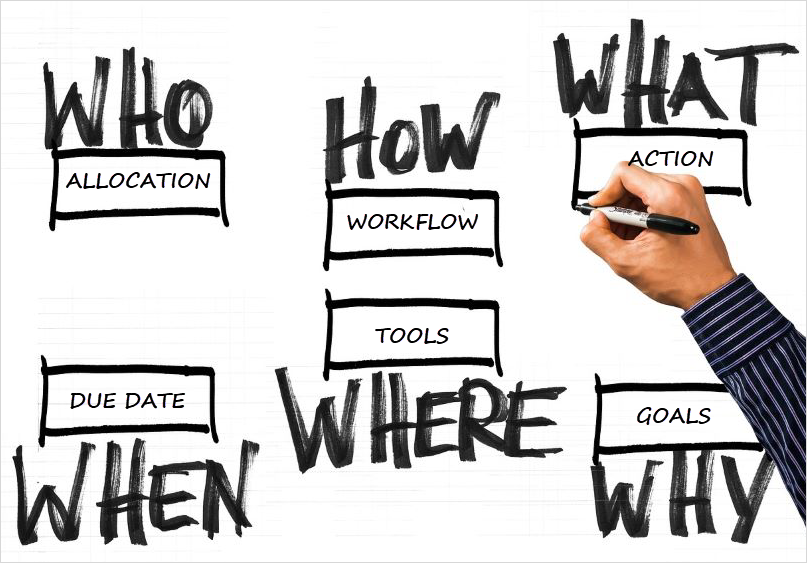
- Why(The Reason): Explain the bigger picture, so everyone knows why the work matters.
- Ask: “Why are we doing this?”
- What (The Work): Be clear about the actual task and what the final result should look like.
- Ask: “What exactly needs to be delivered?”
- Who (The Owners): Assign one clear owner for every task so there is no confusion.
- Ask: “Who is responsible for finishing this?”
- When (The Timing): Set a firm deadline and mention any important dates along the way.
- Ask: “When is the final deadline and the first check-in?”
- How (The Style): Decide if this should be a quick chat, an email, or a formal meeting.
- Ask: “How are we going to talk about this?”
- Where (The Hub): Pick one place to keep all the files and notes so nothing gets lost.
- Ask: “Where can I find all the project info?”
5 Steps to improve Team Communication:
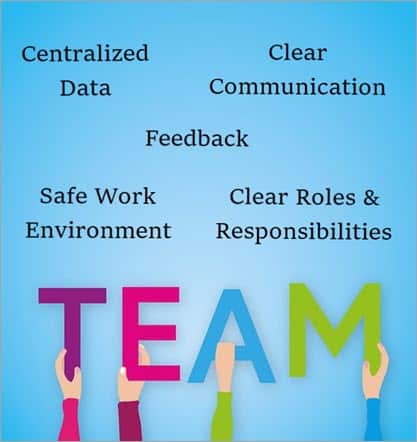
- One Place for Everything: In a world of fragmented apps, teams often lose information in email threads or private chats. Promoting a centralized system (like a CRM or Project Management tool) ensures that everyone has access to the same customer notes, project statuses, and history. This reduces “information silos” and prevents double work.
- Define Clear Communication Norms and Channels: Not every message needs an quick response. High-performing teams set “norms”; for example, using Slack/Chat for quick updates, Video Calls for complex brainstorming, and Email for formal documentation. This prevents notification fatigue and helps employees stay focused on deep work.
- Create a Safe Work Environment: This is the human element of communication. If employees are afraid to speak up or admit a mistake, your communication tools won’t matter. Encouraging a culture where feedback is welcomed and mistakes are seen as learning opportunities is the foundation of effective teamwork.
- Implement Structured Feedback Loops: Communication goes both ways. Regular check-ins and feedback loops help managers identify roadblocks early. Using meeting summaries and automated task lists ensures that follow-up items are never forgotten.
- Define Clear Roles and Responsibilities: Clear ownership prevents miscommunication. Use tools to assign every task a specific owner and deadline. When responsibilities are visible, ambiguity disappears across the entire customer lifecycle.
Tips for maintaining communication in remote work environments:
- Work on your own time: In a remote setting (especially across time zones), not every response can be immediate. Rely on detailed messages or voice notes that team members can digest and reply to on their own schedules.
- Create a “Virtual Water Cooler”: Remote workers miss out on casual office chatter. Set up dedicated chat channels (like #random or #weekend-plans) where the team can talk about non-work topics to build rapport and trust.
- The “5-Minute Rule”: If a text or chat thread goes back and forth for more than 5 minutes without a resolution, jump on a quick 2-minute call to clear the air.
- Respect “Off-Hours”: Use “Send Later” features for emails or chats if you’re working late. Respecting time zones is the ultimate sign of a professional remote communicator.
- Standardize Statuses: Encourage the team to use status icons (e.g., 🗓️ in a meeting, 🎧 deep work, 🍱 at lunch) to manage expectations instantly.
- Balance Video and Audio: While video calls are great for reading body language, “Zoom fatigue” is real. Make video optional for routine check-ins to keep the team energized.
- Video-On for “Human” Moments: For 1-on-1s or sensitive feedback, turn on the camera. Seeing facial expressions builds trust that text simply can’t.
Use OfficeClip to support Effective Communication:
With more than two decades of building CRM, contact management, and time-tracking solutions for small businesses worldwide, OfficeClip has seen the same communication patterns repeat across many teams. Important customer details are buried in individual inboxes, updates are shared in multiple channels without a single source of truth, and tasks fall through the cracks because nobody is clearly accountable.
By centralizing contacts, activities, and projects in one shared system, our customers create more transparent communication and smoother workflows.
- One Central Hub: No more hunting for info. OfficeClip stores all customer emails, documents, and invoices in one place so your team has a single source of truth.
- Total Transparency: Every team member sees the same real-time updates. This keeps everyone on the same page regarding the sales cycle and customer needs.
- Clear Accountability: Easily assign tasks with specific deadlines. When everyone knows exactly what they are responsible for, “who’s doing what” confusion disappears.
- Data-Driven Check-ins: Use built-in time tracking to see project progress at a glance. It allows for more meaningful updates without the need for constant status meetings.
- Seamless Collaboration: By connecting your contacts directly to your tasks, you create a smooth workflow that builds trust and stronger relationships across the whole team.
The Power of Teamwork:
See an example of how effectively your team will work as a result of effective communication, and how this unity will help achieve organizational goals.
Key Takeaways from the above video:
The Power of Unified Teamwork:
- From Individual Effort to Collective Success: The video illustrates how separate tasks, when properly communicated and aligned, come together to achieve a singular organizational goal.
- Visualizing Synergy: See how clear directions and open communication channels allow team members to build upon each other’s work, rather than working in isolation.
- The Foundation of Growth: Discover why a unified approach—supported by the right collaboration tools—is the essential “extra step” that drives long-term business progress and productivity.
Conclusion:
Effective communication is more than just talking more; it’s about communicating better. As we’ve explored, the difference between a struggling team and a high-performing one often comes down to the tools they use and the culture they build. By centralizing your data, defining clear roles, and closing the feedback loop, you eliminate the friction that slows your business down.
As seen in the video above, when individual efforts are unified through clear communication, the results are transformative. It isn’t just about avoiding errors; it’s about creating an environment where innovation thrives and employees feel empowered.
Like it is said, best work comes out with open communication and ideas between team members.
Effective collaboration has a direct impact on business. It is a key to increasing long-term productivity and an extra step towards progress.
Let us know your thoughts about effective communication.
Ready to transform your team’s collaboration?
With OfficeClip’s suite of tools, you can centralize data today and watch your team’s productivity soar!
Image Courtesy:
Note: This blog was created in 2022 and has been updated.

Deepa Kapoor is an online writer for small businesses. She loves to write on the advancements of new technologies and how it affects our lives. She always explores ways to make small businesses more profitable. When not writing, she enjoys reading books and cooking exotic traditional food.


